
What Horses Know About Our Nervous System and Why It Matters
By Joanne Oakes | Trusting Connections | Herd Notes - Stories & Wisdom from the Paddock
There is something that happens when you step into a paddock with a horse. Something that is hard to put into words, but that almost everyone feels, whether they have spent time around horses all their life or whether it is their very first encounter.

The breathing slows. The shoulders soften. The busy, tangled thoughts that followed you throughout the day seem to quieten, just a little. The world narrows down to the moment. The breath. The beautiful, warm, knowing creature standing quietly beside you. The horse.
For a long time, people put this feeling down to ‘fresh air’ or ‘being out in nature.’ And while there is certainly something to be said for the hinterland where we live, I have come to believe, through years of watching it happen again and again with Star, Koda and Shadow, that what people experience beside a horse is something far more specific. Far more remarkable. Science is beginning to discover this too!
Horses Are Masterful Readers of Our Inner World
Horses are prey animals. Their survival has always depended on an exquisitely tuned ability to read the emotional state of those around them, whether human or otherwise. They don't assess what you say. They assess what you are, in this moment, in your body.
Your heart rate. Your breathing rhythm. The tension in your muscles. The energy you carry as you approach the gate and them.
They notice all of it, and they respond to all of it. Authentically, honestly, and without a single word.
Research is starting to show that horses are not only able to perceive human emotional states but respond physiologically to the stress levels of the humans they interact with. When we are calm, they tend to settle. When we are anxious or dysregulated, they notice that too. This two-way responsiveness is what makes time with a horse feel so different from other experiences. It is not a one-sided encounter. It is a conversation and one that happens entirely beneath the level of language.
The Heart-to-Heart Connection
When a human heart and a horse's heart are in close proximity something amazing happens.

Horses have an electromagnetic heart field that is significantly larger than our own. Standing beside them, something in our own physiology seems to respond to that steady, coherent field. Heart rate slows. The nervous system shifts from that familiar ‘on guard’ setting, what we know as the fight or flight response, toward something calmer, more open.
I have watched this happen with Star more times than I can count. She would stand very still, and anyone who had arrived tightly wound and anxious would simply... begin to let go. Not because anyone instructed them to. Not because they were following a breathing exercise. But because something in Star's steady presence made it feel safe to exhale. Even those intimidated by her giant size and adamant that they would not approach her, eventually would be stood close by her, gently stroking her.
What the Research Tells Us About Stress and Anxiety
The research into equine-assisted intervention and its effects on human stress is growing steadily, and the findings are genuinely meaningful.

A 2024 study published in the Journal of Equine Veterinary Science found that short-term equine interaction led to a measurable reduction in anxiety and a corresponding decrease in the stress hormone cortisol, the very hormone our bodies produce when we are anxious, overwhelmed or in a state of threat. Participants' nervous systems, put simply, calmed down.
And in April 2026, Professor Henrika Jormfeldt of Halmstad University released findings from her research into equine-assisted therapy with children and adolescents reporting that it can contribute to improved wellbeing, enhanced self-esteem and better ability to cope with everyday life.
I did not need a research paper to tell me this was possible. I had watched it happen in our own paddock, season after season. But there is something quietly powerful about knowing that what we witnessed here, what Star, Koda and Shadow gave so freely to so many, is now being confirmed and documented by researchers around the world.
Koda, Shadow and the Art of Regulation
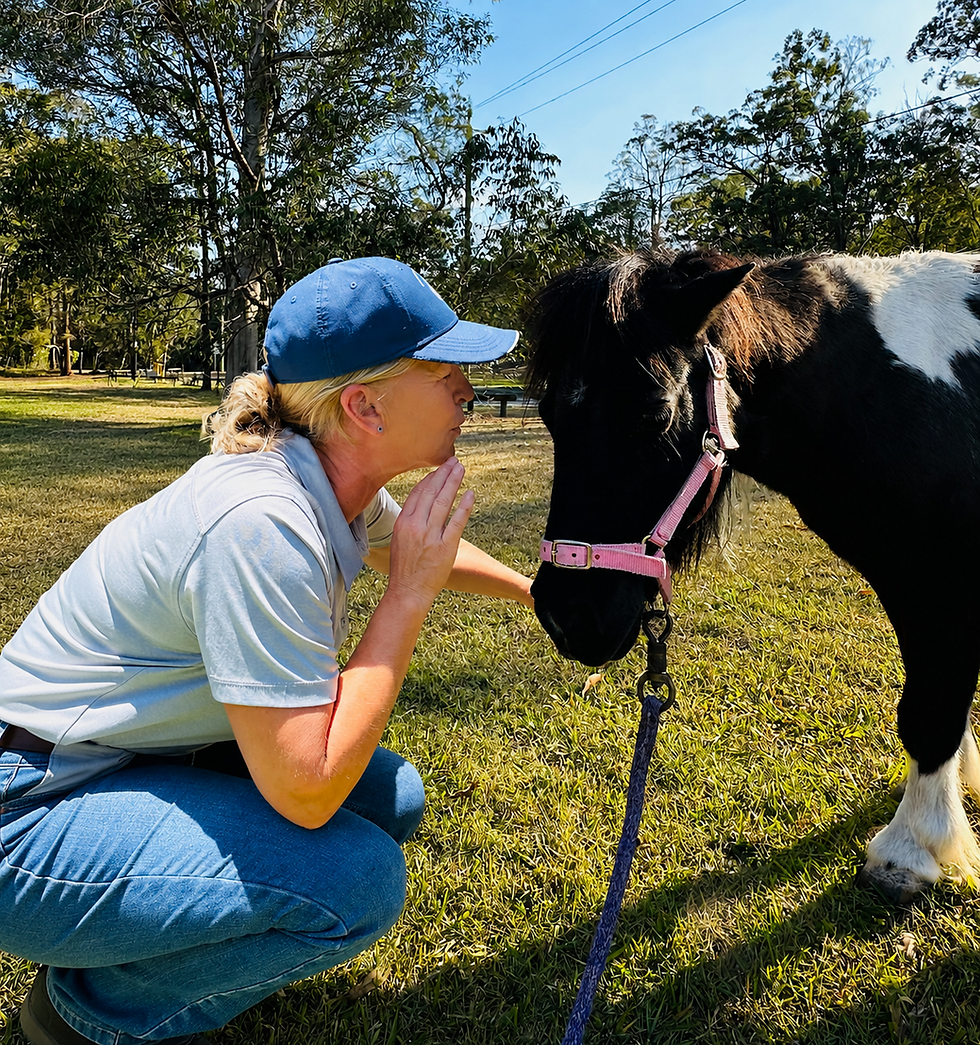
Each of my three horses taught me something different about what regulation actually looks like.
Shadow has always been the most precise mirror. She reflects back what you bring. A child who arrives scattered and overstimulated will often find Shadow gently moving away, not rejecting, but inviting. Come back to yourself first. A child who arrives soft and willing will find her extraordinarily present, warm, and close by. She has an uncanny ability to show you exactly where you are, without judgement, and with extraordinary gentleness.
Koda, our cheeky little buckskin mini pony, teaches something slightly different. He asks for authenticity.

He is not particularly interested in performing connection, he would rather be grazing, honestly, but when someone stops trying, stops overthinking, and simply becomes genuinely curious and present, Koda notices. Something shifts in him. He leans in. It is as if he is saying, there you are. Now we can be together.
And Star. Star, with her extraordinary gentleness and that wise, quiet gaze, has been present for more healing moments than I could ever describe. She seems to know, instinctively, who needs her to stand very still. Who needs to be held in that way, that warm, living, unhurried presence, that no human can quite replicate.
What all three of them do, in their different ways, is offer co-regulation. When a nervous system that is dysregulated, whether anxious, overwhelmed, shut down, comes into contact with one that is calm, steady and present, something begins to transfer. Not through strategy. Through proximity. Through attunement. Through the oldest kind of connection there is.
What This Means for Children and for All of Us

We live in a world that moves fast. A world that asks a great deal of our nervous systems, adult and child alike. Anxiety in children is rising. Many families are searching for gentle, meaningful ways to help little ones understand and navigate the big feelings that come with being human.
What horses remind us is that regulation is not just a cognitive skill. It is not something we can think our way into. It is an experience. A bodily, relational, felt experience of safety and calm. Horses offer that in a way that is immediate, honest, and deeply accessible, even to children who have not yet found the words for what is happening inside them.
From the Paddock to Your Home
Everything that Star, Koda and Shadow showed to the children and families who came to visit us here in

Mudgeeraba, the breathing, the stillness, the grounding, the quiet trust that every feeling will pass is something I have wanted to carry further than our little paddock gate for a very long time.
That is what Hoofbeats and Heartbeats: Wisdom from the Herd was born from. Six years of watching these three horses do something extraordinary, simply by being themselves.
Their wisdom does not stay at the fence. It travels. To families far and wide.
With warmth, Joanne, Trusting Connections | www.trustingconnections.com.au
Research references:
Pratt-Phillips, S.E. & Liburt, N.R. (2024). Short-term equine interaction for reducing test anxiety and facilitating coping skill development in college students. Journal of Equine Veterinary Science.
Jormfeldt, H. (2026, April). Equine-assisted therapy may improve wellbeing among children and adolescents.Halmstad University Research Release.


Comments